2025: The Year AI Became My Execution Partner

2025: The Year AI Became My Execution Partner
348 days, 809 million tokens, and countless hours saved—how Cursor IDE let me be both a leader and a builder.
📊 The Numbers That Tell the Story
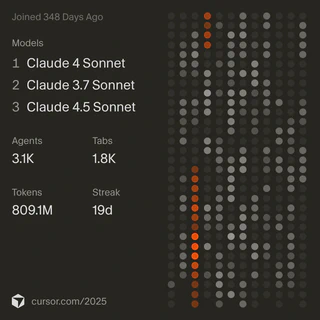
When I look at my Cursor wrapped for 2025, the numbers are staggering:
- 348 days on the platform
- 3.1K agent sessions — autonomous coding workflows
- 1.8K tab completions — intelligent code suggestions
- 809.1M tokens processed — the raw fuel of AI-assisted development
- 19-day streak — consistency that compounds
But numbers alone don’t capture what really changed. What changed was how I balance building with leading.
� The Leadership Itch: Too Much Managing, Not Enough Building
As Lead of Data Engineering, my calendar is a mosaic architecture/code reviews, stakeholder syncs, and team workload management. Management comes with the territory—and I genuinely enjoy growing teams and shaping strategy.
But there’s always been an itch.
That itch to dive deep into a codebase. To refactor something ugly into something elegant. To ship a solution you architected and implemented with your own hands. The kind of work that originally drew me to engineering.
The cruel irony of leadership is that as your influence grows, your time to build shrinks. Every hour spent coding is an hour stolen from something else—team support, roadmap planning, cross-functional alignment. The itch never goes away; you just learn to suppress it.
Until 2025.
🚀 The Multiplier Effect: Having It Both Ways
Cursor and AI didn’t give me more hours in the day. They gave me more output per hour.
What used to take an evening of focused coding—tracing through unfamiliar code, writing boilerplate, debugging edge cases—now takes a fraction of that time. The AI handles the mechanical translation of intent to code, leaving me with the parts I actually enjoy: designing systems and solving problems.
This changed everything:
- Management didn’t suffer — I still had bandwidth for my team, for strategy, for the human side of leadership
- Building became possible again — I could overhaul entire codebases, not just review PRs
- The itch got scratched — I shipped real, substantial work with my own hands
It’s not that AI writes my code for me. It’s that AI amplifies my thinking. Every keystroke becomes more valuable. Every decision gets more consideration. Every system gets designed rather than hacked together.
🧱 The Blockchain Harvester: Proof That Leaders Can Still Build
The best example of this multiplier effect? The Blockchain Harvester — a multi-chain data extraction platform I built to handle everything from Ethereum to Solana-scale throughput.
This wasn’t a weekend hack or a proof-of-concept. It was a full-fledged platform overhaul—the kind of project I would have had to delegate, design and do it myself in a pre-AI world:
- Multiple blockchain protocols with different data models
- High-throughput requirements — Solana produces blocks every 400ms
- Complex async patterns — pipelined processing, backpressure handling, graceful degradation
- Production-grade reliability — retry logic, progress tracking, atomic batch semantics
With Cursor, I could actually build this while still being present for my team. The AI compressed what would have been weeks of coding into days—without sacrificing depth or quality.
I designed the three-layer pipeline pattern (Extractors → Processors → Exporters) while the AI helped implement the concurrency primitives. I thought through the “3 Vs” challenge (Volume, Velocity, Variety) while the AI helped translate those constraints into code.
The result? A unified codebase that handles a dozen different blockchain architectures—all in Python, using nothing more exotic than async/await, ProcessPoolExecutor, and threading. Good architecture beats complexity, and AI gave me the breathing room to find that good architecture.
💡 What I’ve Learned About AI-Augmented Development
After 348 days, some patterns have emerged:
1. AI is a execution partner, not a replacement
The best results come from dialogue. Explain your constraints. Challenge the AI’s suggestions. Iterate on solutions together. The AI doesn’t replace your judgment—it amplifies it.
2. Context is everything
The more context you provide, the better the output. I’ve learned to structure my projects, write clear comments, and maintain comprehensive documentation. It makes the AI more effective, and coincidentally, makes the codebase better for humans too.
3. The skill shifts, but doesn’t disappear
You still need to understand what good code looks like. You still need to architect systems thoughtfully. You still need to debug when things go wrong. AI changes the ratio of how you spend your time, but it doesn’t eliminate the need for expertise.
4. Speed enables experimentation
When implementation is fast, you try more things. You explore edge cases. You refactor aggressively. The velocity itself changes how you approach problems.
🎯 Looking Forward: Leaders Who Build
2025 proved something I wasn’t sure was possible: you can lead and build at scale.
AI-assisted development isn’t about replacing engineers—it’s about amplifying them. For leaders who miss the hands-on work, it’s a way back to the craft without abandoning the responsibilities that come with seniority.
The question isn’t whether to adopt these tools; it’s how to adapt your workflow to maximize their leverage. For me, the answer has been clear: use AI to handle the mechanical, so you can focus on the meaningful. Lead your team. Shape strategy. And ship code.
809 million tokens later, I’m not just more productive. I’m the engineer I always wanted to be—one who leads without losing touch with the work.
Here’s to another year of thinking bigger, building faster, and proving that leaders can still ship. 🚀
